Krestianstvo Wavefront Evaluator
What is KWE?
Krestianstvo Wavefront Evaluator (KWE) is an open-source computational engine that replaces the traditional virtual-machine execution model with wavefront propagation. Rather than routing causality through a central message scheduler, KWE propagates effects as physical waves through a graph of locally autonomous nodes — each node that receives a message becomes a secondary wave source, directly instantiating Huygens’ principle in software.
The result: deterministic multi-peer synchronisation as a structural consequence of the execution model, not as an engineering add-on. Any number of browser peers, given the same initial state (“initial energy”) and the same program (“laws of physics”), converge to identical state — without exchanging simulation data.
Core Ideas
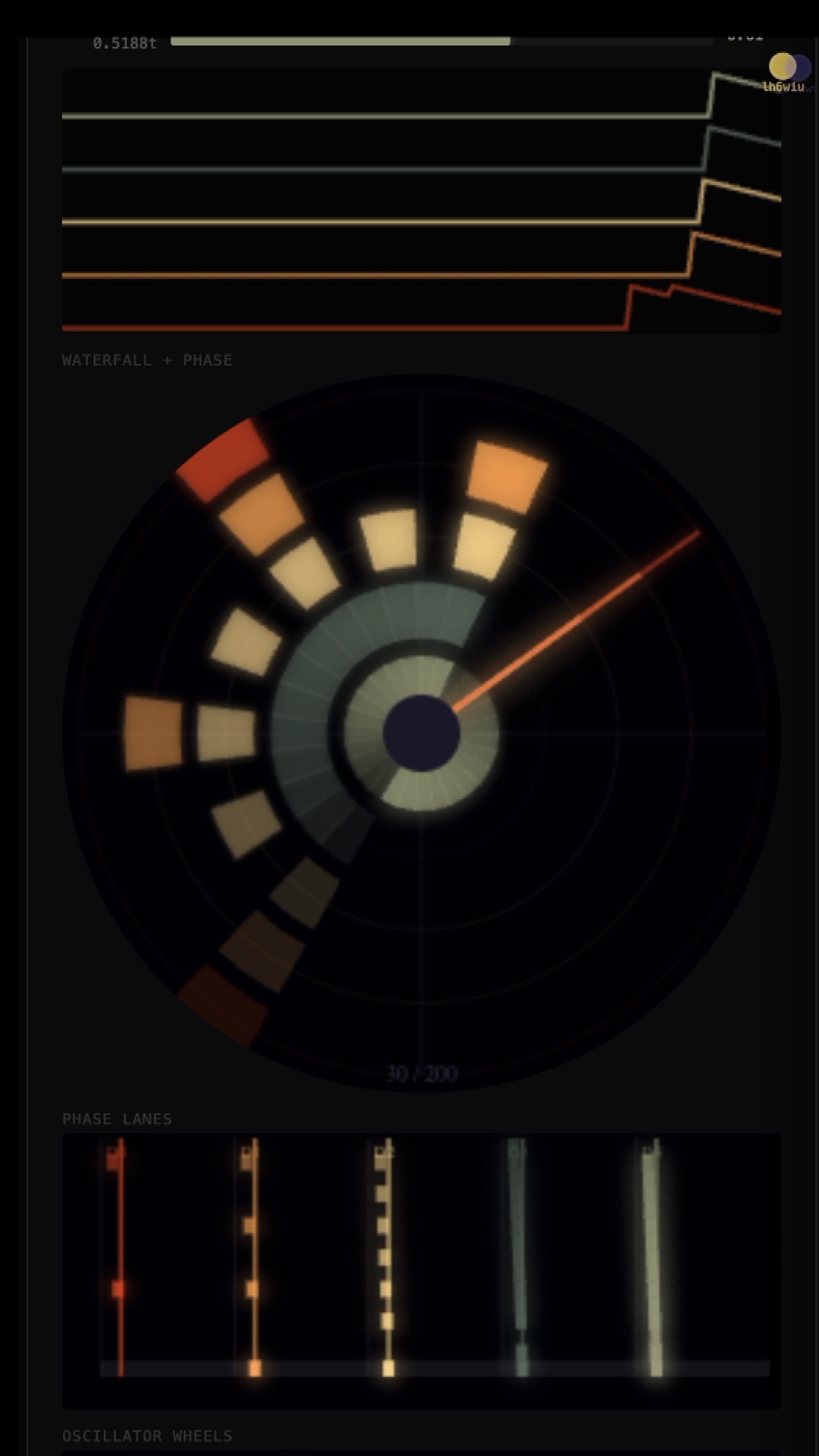
Section titled “Core Ideas”The clock at the core of KWE is not a metronome — it is an IFS attractor that generates its own time. A self-similar cascade of virtual beats unifies time-stepping, spatial quadrature, wavelet decomposition, and distributed synchronisation in a single mechanism.
KWE performs holography natively inside a fractal medium. Holographic redundancy — the cut-in-half property — is proven and depth-gated: any fragment of the hologram reconstructs the whole scene. The third dimension is the clock.
A standard simulation treats the computer as a calculator operating on a matrix. KWE treats the computer as a medium. The simulation is causal by construction — a ripple radiates outward, hits a neighbour, triggers the next beat. Space-time emerges from the fractal topology.
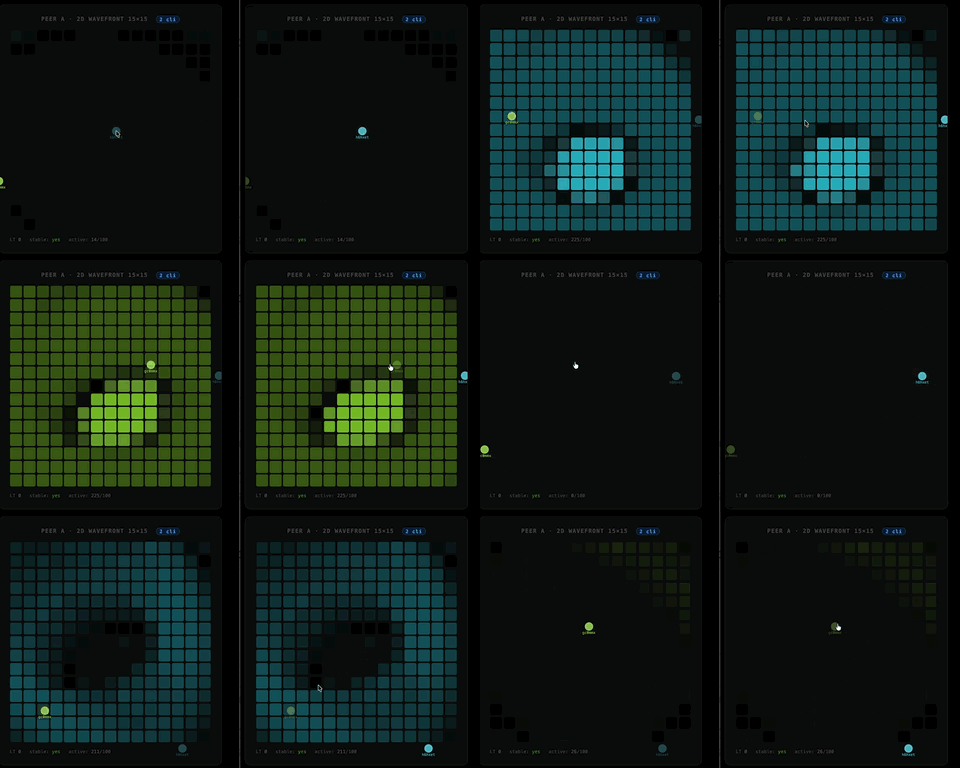
Identical initial state + identical program = identical output on every peer. No simulation data traverses the network. Determinism is a structural consequence, not a protocol. All examples run live in the browser sharing a WebSocket reflector, pixel-exact across peers.
Key Results
Section titled “Key Results”- Wavefront execution model — causal propagation without central scheduler
- Deterministic multi-peer convergence — no simulation data on the wire
- IFS fractal time as unified substrate — time, space, wavelets, and sync
- Exact holographic reconstruction — 100% energy, no Gerchberg–Saxton iteration
- True holographic redundancy — cut-in-half property, depth-gated at T≈350
- Emergent fractional dispersion in NLS — effective order from IFS geometry
- Soliton collision / pass-through — under fractional IFS dispersion
- Topological instantons — vortex-driven A→B vacuum tunneling
- Instanton hologram — recording a topological event, not a static scene
- Holographic eye — live 5-stage perception pipeline with soliton percept
Wavefront propagation, causal structure, and physics simulations as proof-of-concept.
How the IFS clock generates its own spacetime — construction, self-defining loop, microticks, and light cones.
True holographic redundancy in a fractal medium — proven depth-gated cut-in-half property, holographic eye.
Graphics without frames — a continuous self-organising NLS field where the display is the physics.
Core vocabulary, architecture layers, meta program, W runtime, and distributed determinism invariants.
W.reduce, ctx primitives, W.stable, W.localReflector, W.rng, and sub-tick scheduling patterns.
All 12 demos — counter, wavefront, fractal heartbeat, holography, solitons, instantons, holographic eye.
Extending Functional-Reactive programming with the notion of Fractal Time.
© Nikolay Suslov · Krestianstvo.org | 2026